
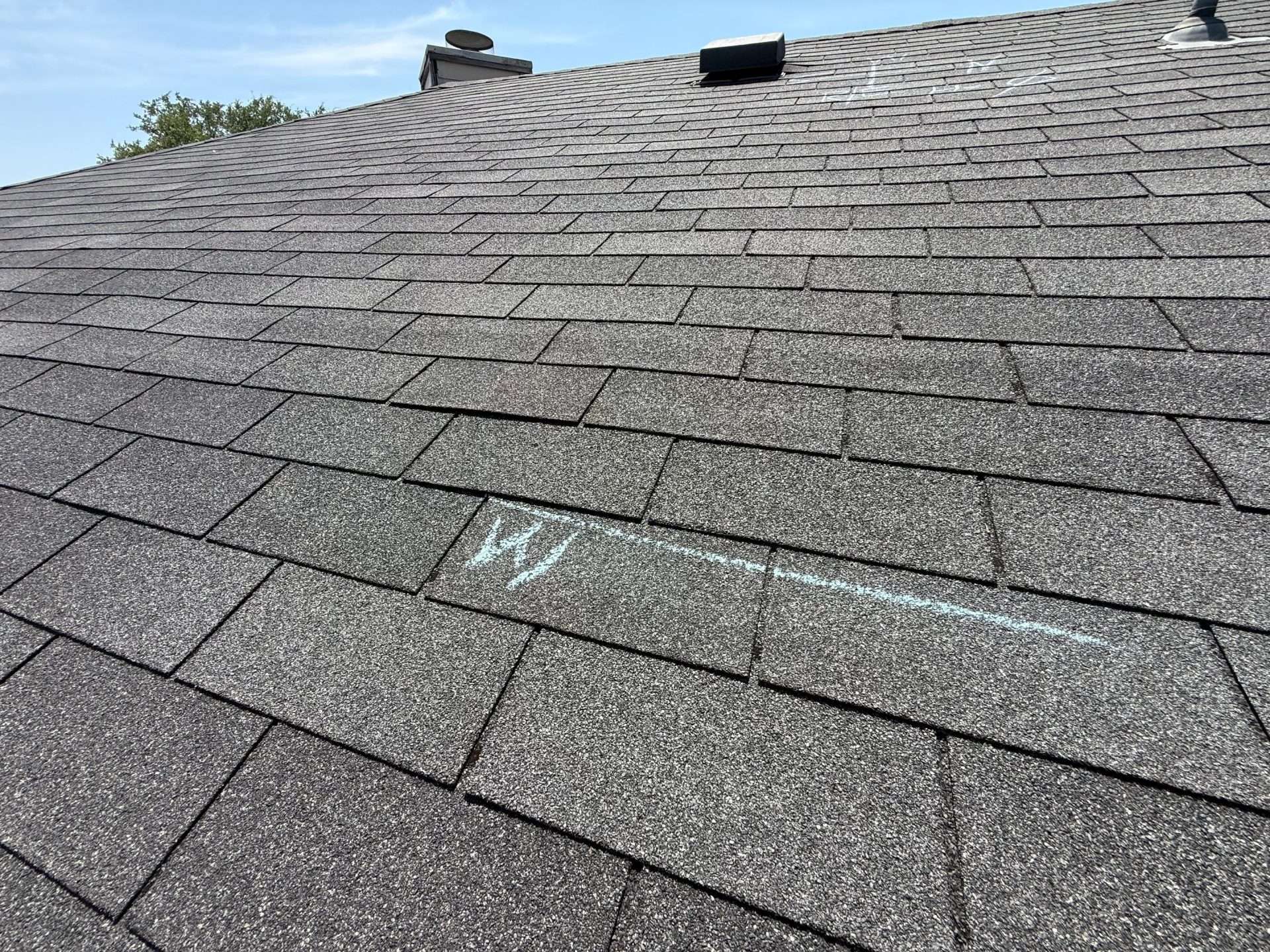
Hail damage is sneaky — the worst of it is rarely visible from your driveway, and some of it won’t leak for months. Here’s how to tell whether that storm actually hurt your roof, straight from the inspectors who document it every week across DFW.
What Size Hail Will Damage a Roof?
As a general rule, hail around 1 inch (quarter-sized) and up can cause functional damage to asphalt shingle roofs — and that threshold drops for older or already-weathered shingles. Smaller hail usually doesn’t hurt shingles but can dent soft metals like gutters, vents, and flashing, which is often the first visible clue a storm hit hard enough to matter. Golf-ball hail and larger will damage almost any asphalt roof it hits. Roof age, wind speed, and shingle quality all play a role — Class 4 impact-resistant shingles can shrug off hail that destroys standard 3-tab shingles.
Signs Your Roof Has Hail Damage
From the ground, look for: dented gutters and downspouts, damaged window screens or frames, dings in painted fascia, pockmarked AC fins, and shingle granules piling up in gutters and splash areas. On the roof itself — which we don’t recommend homeowners climb — hail damage shows up as dark round bruises where granules were knocked away, soft spots that feel like a bruised apple, cracked or split shingles, and dented vents and pipe jacks.
Some of the most serious damage is the hardest to see: fractured shingle mats that won’t leak for months but have already lost their integrity. That’s why APGC provides free photo-documented inspections — we chalk-mark, photograph, and measure everything we find so you can see exactly what the storm did without leaving your living room.
Dents and Spatter on Shingles — Is That Hail Damage?
Spatter marks — dark stains where hail knocked algae or oxidation off surfaces — are storm evidence: they prove hail fell, but they’re usually cosmetic. Dents in soft metals are stronger evidence and help establish hail size and direction. What insurance actually pays for is functional damage: granule loss exposing the asphalt mat, bruises that fracture the mat, and cracked or punctured shingles. The good news: spatter and dented vents are the classic sign a real inspection is warranted, because hail that dented your vents very likely bruised your shingles too.
Hail Damage vs. Normal Wear and Tear
This distinction decides insurance claims. Hail damage is random and impact-shaped: round bruises scattered irregularly, hits on soft metals that match the roof damage, and damage concentrated on storm-facing slopes. Wear and tear follows patterns: uniform granule loss, heat blistering, consistent cracking, and curling edges spread evenly across slopes. Insurance covers sudden storm damage; it doesn’t cover aging.
APGC’s inspectors carry Building Experts Institute (BEI) credentials in hail and wind damage identification for asphalt shingle roofs, and our documentation distinguishes storm impacts from age so your claim rests on defensible evidence. If your roof is just old, we’ll tell you that honestly and quote a replacement instead. Wind got there first? Here’s how to spot wind-damaged shingles too.
Get a Free, Photo-Documented Roof Inspection
American Prime General Construction is a veteran-led, BBB A+ accredited roofing contractor based in Richardson, serving the entire DFW metroplex. If hail has hit your neighborhood, our BEI-credentialed inspectors will document exactly what the storm did to your home — free, with no obligation. Call or text our 24/7 storm line at (469) 888-8326 or request your free inspection online.
Want a definitive answer instead of a guess? A certified forensic roof inspection is a paid, evidence-based evaluation performed to a defined professional standard by a BEI certified forensic inspector, and it separates cosmetic wear from functional storm damage in a written report you keep. Inspections start at $800.
This article is general information for Texas homeowners, not legal or insurance advice. American Prime General Construction is a general contractor — not a public adjuster, insurance agent, or law firm — and does not adjust, negotiate, or settle insurance claims on behalf of policyholders. For advice about your specific policy or claim, contact your insurance agent or carrier, the Texas Department of Insurance (tdi.texas.gov, 1-800-252-3439), a licensed public adjuster, or an attorney.